A missing tooth can change more than the look of your smile. It may affect how confidently you eat, speak and laugh, while allowing neighbouring teeth to shift over time. When weighing up implant vs dental bridge, the best choice is rarely about choosing the ‘best’ treatment in general. It is about choosing the replacement that respects your oral health, lifestyle, comfort and wider wellbeing.
At Dental + Skin Clinic, we see this decision as a personal one. A thoughtful consultation considers the condition of your teeth and gums, jawbone health, bite, medical history, material preferences and how you would like your smile to feel in everyday life.
Implant vs dental bridge: the core difference
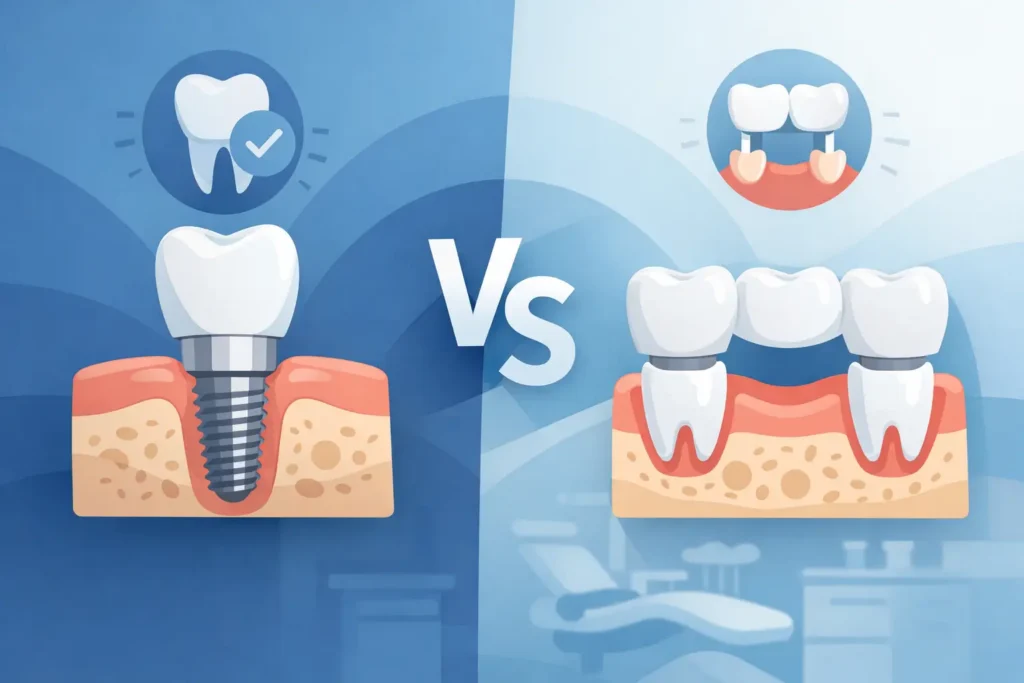
A dental implant replaces the root and crown of a missing tooth. A small titanium post is placed in the jawbone, where it integrates with the bone over time. Once it is stable, a custom crown is attached to create a natural-looking replacement tooth.
A dental bridge replaces the visible part of the missing tooth by connecting a false tooth, called a pontic, to the teeth on either side. With a conventional bridge, the neighbouring teeth are prepared so crowns can support the replacement tooth between them. Some patients may be suitable for a more conservative resin-bonded bridge, which is attached to the back of an adjacent tooth.
Both options can restore a gap beautifully. The meaningful differences lie in preparation, treatment time, maintenance and the way each option interacts with your surrounding teeth and jawbone.
Why an implant may be the right choice
An implant is often considered when you want a stand-alone replacement that does not rely on neighbouring teeth for support. This can be particularly appealing when the teeth beside the gap are healthy and do not otherwise need crowns.
Because the implant post sits in the jawbone, it can help maintain stimulation in the area where a natural tooth root once sat. After a tooth is lost, the bone in that part of the jaw can gradually reduce in volume. An implant cannot reverse every change, but it may support the preservation of bone better than a bridge that sits only above the gumline.
For many people, an implant also feels very close to a natural tooth. It is fixed in place, does not need to be removed and can make chewing feel more secure. With attentive brushing, interdental cleaning and regular dental reviews, an implant crown can provide a long-term solution.
There are trade-offs. Implant treatment involves a surgical procedure and a healing period. Depending on your individual needs, the process may take several months from planning to final crown placement. If there has been significant bone loss, a bone graft may be recommended before or alongside implant placement, which can add time and cost.
Implants are also not automatically suitable for everyone. Active gum disease needs to be stabilised first, and factors such as smoking, uncontrolled diabetes, certain medications, clenching and grinding, or limited bone may affect planning. None of these necessarily mean an implant is off the table, but they call for careful, individual assessment.
Materials and a wellness-led approach
Titanium implants are widely used and have a substantial clinical history. Some people are interested in alternatives, including ceramic options, because of their personal material preferences or holistic health philosophy. Availability and suitability depend on the clinical situation, and it is worth having an open conversation about the benefits, limitations and evidence for any material being considered.
A whole-body approach should never mean overlooking the fundamentals. Healthy gums, stable bite forces, good oral hygiene and a plan that feels emotionally manageable all matter to the long-term outcome.
When a dental bridge can make more sense
A bridge can be an excellent solution when you want to replace a tooth without surgery, or when an implant is not clinically appropriate. It may also be the more efficient pathway if the teeth next to the gap already have large fillings, existing crowns, cracks or wear and would benefit from protective crowns anyway.
Treatment is generally completed more quickly than an implant. After the supporting teeth are prepared, impressions or digital scans are taken, and a temporary bridge may be placed while your final restoration is made. The finished bridge is then bonded into place.
A well-designed bridge can restore your smile, support speech and help spread chewing forces more evenly. It is fixed, so there is no need to remove it for cleaning. For patients who feel anxious about surgery or would prefer a shorter treatment timeline, this can be a reassuring option.
The main consideration is that a conventional bridge usually requires reshaping the teeth either side of the gap. If those teeth are completely healthy and untouched, some people prefer to preserve them and consider an implant instead. Bridges also need special cleaning beneath the pontic, using tools such as floss threaders or interdental brushes, to keep the gumline healthy.
Over time, a bridge may need repair or replacement. If one supporting tooth develops decay, gum disease or a crack, the whole bridge can be affected. This does not make bridges a poor option. It simply makes careful design, daily care and regular monitoring especially valuable.
Comparing treatment time, cost and maintenance
The right choice often becomes clearer when the practical details are discussed honestly.
An implant usually has a higher upfront cost because it involves surgical planning, placement of the implant, healing appointments and the final crown. A bridge is often less costly at the beginning and can be completed sooner. Yet the long-term picture is individual: a bridge may need replacement in the future, while an implant may require maintenance of its crown or components. Looking only at the first quote can miss the broader value of protecting your surrounding teeth and supporting your long-term oral health.
Cleaning is also different. An implant crown is brushed and flossed much like a natural tooth, although the gumline needs particular attention. A bridge requires cleaning around the crowned teeth and underneath the false tooth, where plaque can collect. Your dental team can show you a technique that feels simple enough to sustain at home.
Neither treatment is truly ‘set and forget’. Both depend on healthy gums, consistent home care and professional cleans. If you clench or grind your teeth, a custom mouthguard may help protect the restoration and your natural teeth from excessive forces.
What about appearance and comfort?
Modern crowns and bridges can be carefully matched to your natural tooth colour, shape and smile line. The aesthetic result depends on thoughtful planning, quality materials and the health of the gums around the restoration.
An implant may offer a very natural appearance because it emerges through the gumline as an individual tooth. However, achieving a beautiful result in the front of the mouth can require additional gum or bone planning, particularly if the tooth has been missing for some time.
A bridge can also look exceptionally natural, especially when it is designed to complement surrounding teeth. In some cases, it allows a clinician to make subtle improvements to the shape or colour of neighbouring restorations at the same time. Comfort is personal: some patients value the security of a stand-alone implant, while others value avoiding surgery and appreciate the faster route a bridge can offer.
Questions to ask before deciding
Before committing to an implant or bridge, ask how the treatment will affect the teeth beside the gap, whether your gum and bone health are stable, and what maintenance will be needed at home. It is also helpful to ask about the expected treatment stages, likely future costs, material options and what can be done to support comfort if dental treatment makes you feel nervous.
If a tooth has only recently been removed, timing matters. The jawbone and gum tissue change after an extraction, so discussing replacement early may create more options. That does not mean you need to rush into treatment. It means you can make a considered decision with a clear understanding of what waiting may involve.
A replacement tooth should feel like it belongs
The choice between an implant and a bridge is not simply technical. Your smile is part of how you nourish yourself, communicate and feel at ease in the world. The most supportive treatment is one that is clinically sound, aligned with your preferences and realistic for your life.
A personalised consultation can turn a confusing choice into a calm, clear plan – one that protects your oral health while helping your smile feel whole again.